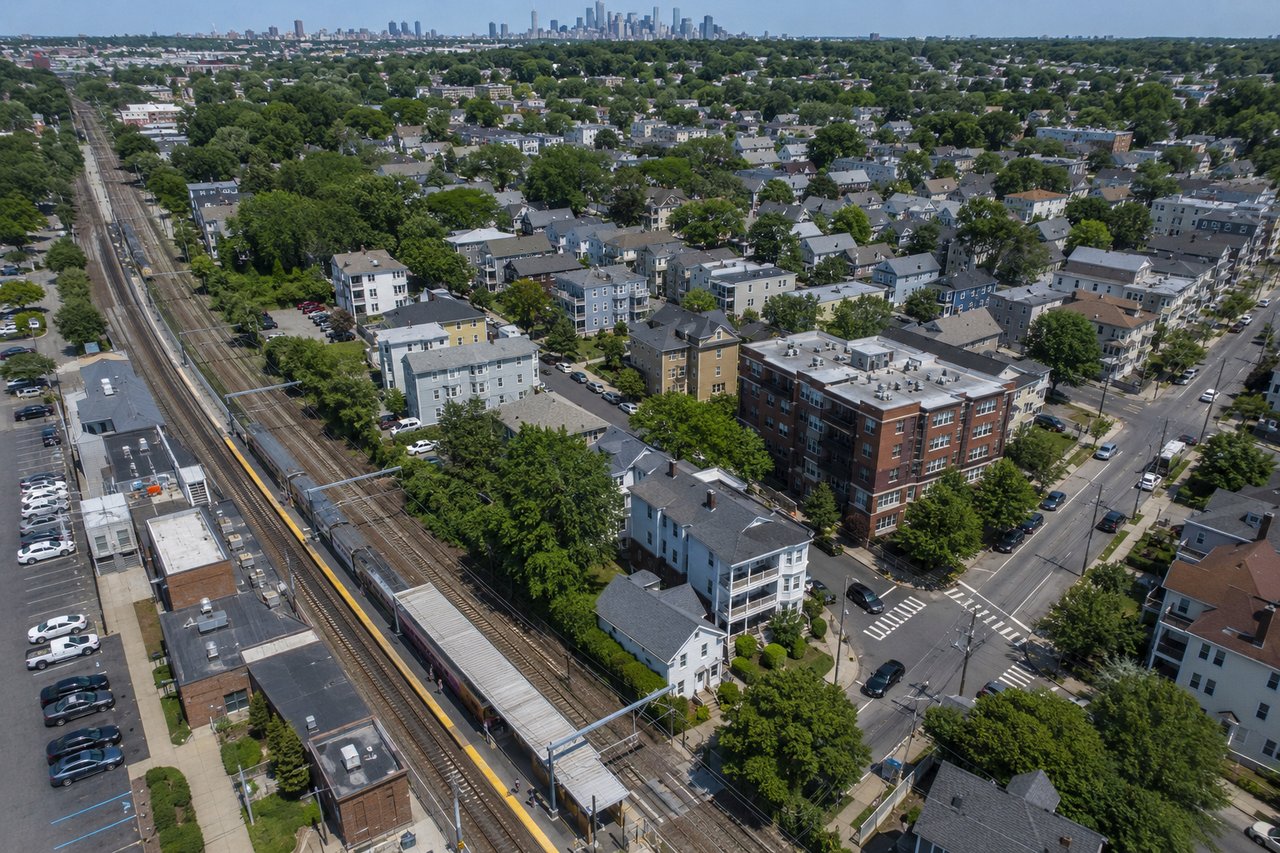
Two state laws have done more to reshape Greater Boston real estate than anything in the last fifty years. The MBTA Communities Act, codified as Section 3A of Chapter 40A, forces 177 cities and towns to allow multifamily housing by right near transit. The Affordable Homes Act of 2024 made accessory dwelling units (ADUs) up to 900 square feet legal by right in every single family zoning district in the state, with the exception of Boston, which has its own ADU ordinance.
If you own a single family home in Newton, Watertown, Arlington, Medford, or anywhere else in the MBTA service area, your property just got more flexible. If you are an investor or developer, the playbook for finding density just changed. This post breaks down what both laws actually do, where the opportunity is, and how to position yourself early.
What Section 3A Actually Requires
Section 3A requires every MBTA Community to adopt at least one zoning district of reasonable size where multifamily housing is permitted as of right. The district has to meet a minimum gross density of 15 units per acre, has to be reasonably close to transit where possible, and cannot impose age restrictions or anti family provisions. As of January 2026, 133 communities are fully compliant, with another seven in conditional compliance and 25 in interim compliance.
The practical effect is simple. In compliant communities, a parcel inside the 3A overlay can be developed as multifamily without a special permit, without a zoning variance, and without a discretionary review process that can be killed at town meeting. That is a massive change in a state where every multifamily project used to require years of hearings and political risk. By right means the local zoning board has to approve it if it meets the bylaw.
For investors and developers, this is the first time in modern Massachusetts history that you can underwrite a multifamily deal in the suburbs without pricing in two years of approvals risk. The land cost calculus changes. The development timeline changes. The cap rate math changes.
Where the 3A Opportunity Is Strongest
Not every 3A district is created equal. The communities with the most opportunity right now are the ones that adopted compliant zoning early, drew their districts in spots with actual redevelopment potential, and have a path to permitting that the planning office can actually run.
Watertown is a strong example. The Pleasant Street and Arsenal Street corridors already had density in the pipeline before 3A, and the new overlay extends that pattern. Arlington adopted compliant zoning along Mass Ave and near Alewife, which puts buildable parcels within walking distance of the Red Line. Medford restructured zoning around Wellington and Ball Square, both of which are now Green Line Extension stops. Malden, Everett, and Chelsea all sit inside the inner core and were already friendly to density.
Newton, Brookline, and Belmont passed compliant bylaws but drew districts more conservatively. The opportunity still exists but the redevelopable parcels are fewer and pricier. Some communities have rejected 3A zoning at town meeting and are now in legal limbo, with no state funding eligibility and unclear enforcement. Those towns are not where investors should be focused right now.
The investor question is not "where can I build by right" in the abstract. It is "which 3A district contains parcels with tear down value, soft second story conditions, or assembly potential." That is a property by property analysis, and it requires someone who works these markets every day.
The ADU Law and Why It Matters for Every Homeowner
The Affordable Homes Act, signed by Governor Healey in August 2024 and effective February 2, 2025, made accessory dwelling units up to 900 square feet legal by right in every single family zoning district in Massachusetts outside of Boston. Towns cannot ban them, cannot require owner occupancy, and cannot impose parking requirements if the ADU is within half a mile of transit.
What does that mean in practice? If you own a single family home in Waltham, Medford, Arlington, Watertown, or any other MBTA Community, you can now legally add a second unit to your property without a special permit. The ADU can be an attached addition, a converted basement or attic, or a detached backyard cottage. It can be rented out long term. You do not have to live in either unit.
This is one of the most underused wealth building tools in Massachusetts real estate right now. A homeowner in Waltham can build a 900 square foot ADU for somewhere between $150,000 and $300,000 depending on whether it is a basement conversion or new construction, rent it for $2,000 to $2,800 a month, and create a cash flowing asset attached to a property they already own. Over a 30 year hold, that is the difference between retiring comfortable and retiring rich.
It also opens up house hacking in a way that was effectively illegal in most of the state until 2025. A first time buyer in Malden or Medford can now buy a single family, build or finish an ADU, and live for free off the rent. That used to require buying a two family, which is a different product entirely.
How Investors and Developers Should Be Positioning Now
The smart money is already moving on three plays. First, assembly in 3A districts. Buying adjacent parcels inside an overlay and assembling them into a developable site is the highest leverage play available in Greater Boston right now, and most owners do not know what their land is worth under the new zoning.
Second, single family acquisitions in 3A overlays that allow tear down redevelopment to multifamily. These are deals that pencil only because the zoning changed, and most listing agents are not pricing them at the new highest and best use.
Third, ADU conversion plays on existing single family rentals. Adding a 900 square foot ADU to a property you already own at scale is one of the fastest ways to add cash flow without acquiring new buildings. The capital requirement per door is far below what it would cost to buy a comparable unit.
What ties all three together is sourcing. The properties that pencil are not on the MLS. They are off market deals, expired listings, tired landlords, and homeowners who do not realize their lot has changed value. That is the wholesale and investor representation work we do at PH Realty Group every day across Newton, Watertown, Waltham, Medford, Malden, Arlington, Cambridge, Brookline, Somerville, and Brighton.
What Homeowners Should Be Asking Themselves
If you own a single family in any MBTA Community, two questions are worth asking. Does my lot have ADU potential, and what is my property worth under the new 3A zoning if it sits inside an overlay district?
The ADU question is the more accessible one for most homeowners. If you have a finished basement, a walkout, a separate entrance possibility, or a yard big enough for a small detached structure, you have an ADU candidate. The financing for this is starting to mature too, with the state developing an ADU Incentive Program and some lenders offering renovation loans that fold in the construction cost.
The 3A question is more situational. If your single family sits inside a 3A overlay in a community like Watertown, Arlington, Medford, or Malden, your land value may be substantially higher than your house value. That changes the calculus on whether to sell, hold, or develop. It is worth getting an honest second opinion before you list traditionally.
Frequently Asked Questions
What is the MBTA Communities Act in Massachusetts?
The MBTA Communities Act, also known as Section 3A of Chapter 40A, is a 2021 Massachusetts law that requires 177 cities and towns served by or adjacent to the MBTA to adopt at least one zoning district where multifamily housing is allowed by right, with a minimum density of 15 units per acre. The goal is to increase housing production near transit. Communities that fail to comply lose eligibility for several state funding programs.
Can I build an ADU in Massachusetts without a special permit?
Yes. As of February 2, 2025, the Affordable Homes Act allows accessory dwelling units up to 900 square feet to be built by right in every single family zoning district in Massachusetts, with the exception of Boston, which has its own ADU ordinance. Local towns cannot require owner occupancy, cannot ban ADUs outright, and cannot require parking if the ADU is within half a mile of transit.
Which Greater Boston towns are best for investors under Section 3A?
Watertown, Arlington, Medford, Malden, Everett, and Chelsea adopted 3A compliant zoning early and drew their overlay districts in locations with real redevelopment potential. These markets offer the best combination of by right multifamily density and parcel availability for investors and developers. Newton, Brookline, and Belmont are compliant but drew more conservative districts, which means fewer redevelopable parcels.
How much can I rent an ADU for in Greater Boston?
A 900 square foot ADU in the inner Greater Boston market typically rents between $2,000 and $2,800 per month depending on the town, the finish level, and whether it is detached or attached. In stronger rental markets like Newton, Watertown, and Arlington, well built detached ADUs can rent at the higher end of that range or above.
Does the new ADU law require me to live in the main house?
No. The Massachusetts ADU law specifically prohibits municipalities from requiring owner occupancy of either the primary dwelling or the ADU. You can rent both units to separate tenants. This is one of the biggest differences between the new state law and the older, more restrictive town bylaws it replaced.
How do I find off market multifamily and investment deals in Greater Boston?
Off market deals come from direct outreach to property owners, relationships with listing agents and wholesalers, expired listing prospecting, and brokers who actively source distressed and underpriced inventory. PH Realty Group runs an active off market acquisition program across the Greater Boston inner suburbs and represents both investor buyers and homeowners selling outside the MLS.
The Bottom Line
Section 3A and the new ADU law are the two biggest pieces of zoning reform in Massachusetts in decades, and most of the market has not caught up to what they mean. For investors and developers, the opportunity is in assembly, redevelopment, and ADU plays before pricing fully reflects the new zoning. For homeowners, the opportunity is in understanding what your lot is actually worth under the new rules.
If you are an investor looking for off market opportunities in 3A overlay districts, a homeowner curious whether your property has ADU or redevelopment potential, or a developer trying to source assembly plays across Greater Boston, get in touch with PH Realty Group. We work these markets every day and we know where the deals live. Reach out at [email protected], call (617) 393 3458, or text (781) 879 0863.