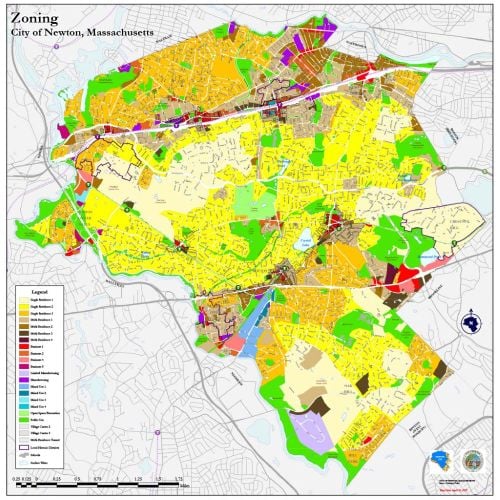
If you own property in Newton, the zoning under your parcel changed recently, and most owners have not registered what that means for value. Section 3A of state law forced Newton to open up large parts of the city to multifamily housing by right. This post explains what actually changed, why it can raise what a Newton parcel is worth, and where it does not move the needle at all.
I run buyer, seller, and investor deals across Newton every week, and the 3A question now comes up on a real share of them. Here is the honest version.
What the MBTA Communities Act Requires
The MBTA Communities Act, written into state law as Section 3A, requires Newton to zone at least one district where multifamily housing is allowed by right at a minimum of 15 units per acre. It is part of Chapter 40A, the state zoning law, and it applies to 177 cities and towns served by or near the MBTA, with Boston exempt.
By right is the phrase that matters. It means a multifamily project that fits the rules needs no special permit and no discretionary approval, which is exactly the step that used to delay or kill these projects in Newton. The law itself does not force anyone to build anything. It only requires the city to allow it.
How Newton Complied and What the Village Center Overlay Changed
Newton complied by adopting the Village Center Overlay District, which layers new by right multifamily zoning over its village centers and nearby parcels, and the state accepted it as meeting Newton's required capacity. Newton is classified as a Rapid Transit community, the highest obligation tier, because of its Green Line and commuter rail access. That set Newton's required minimum multifamily zoning capacity at 8,330 units, one of the largest figures in the corridor, and the state determined Newton compliant in 2025.
The overlay does not rezone the whole city. It targets the village centers, and the dimensional rules, height, and density vary by location, so two parcels a block apart can carry very different potential. This is also not theoretical anymore. In early 2025 the state's highest court ruled that compliance is mandatory and enforceable, and a separate challenge arguing the law was an unfunded mandate was dismissed later that year. The zoning is here to stay. You can see how this plays out across all the corridor towns in our breakdown of MBTA 3A zoning across Greater Boston.
Why This Can Raise What Your Property Is Worth
A Newton parcel that can now support multifamily by right is often worth more than the same parcel limited to a single home, because development potential is part of land value. If your lot sits inside the overlay and the old zoning capped you at one or two units, the right to build a small multifamily building by right is a new asset attached to your land, and developers and investors pay for that optionality.
The size of the change depends on the lot, the specific district rules, and the market, and it is not uniform. A parcel that gains real density can see a meaningful jump. A parcel that gains a little gains a little. This is the analysis I run for owners before they decide to sell or hold, because what a developer will pay for by right potential is often very different from a standard residential appraisal. The details of Newton's districts are laid out on our Newton 3A overlay page.
Why Not Every Newton Parcel Benefits
Plenty of Newton parcels see no value change at all, because they sit outside the overlay, are too small to use the new density, or fall under district rules that limit what you can actually build. The overlay is mapped, so if your lot is outside it, nothing changed for you.
If it is inside but small, the 15 units per acre minimum may not translate into extra units on your specific lot. Setbacks, height limits, and parking rules in the adopted district text can also cap real world capacity well below the theoretical maximum. This is why a parcel has to be checked against the adopted map and the actual zoning text, not assumed to be a winner just because it is in Newton.
What to Do If You Own Near a Newton Village Center
If you own near a Newton village center, the first step is to confirm whether your parcel falls inside the overlay and what the district text actually allows there. Pull your lot against the adopted overlay map. If it is inside, the real question is what the specific district permits and whether your lot is large enough to use it.
From there you can decide whether you are sitting on development potential worth marketing to investors or whether the change is mostly academic for your property. Either way, knowing where you stand beats guessing. If you are weighing a move, our Newton market overview is a good starting point.
Frequently Asked Questions
Did Section 3A change zoning everywhere in Newton?
No. Section 3A added by right multifamily zoning through Newton's Village Center Overlay District, which covers the village centers and nearby parcels, not the entire city. Whether your lot is affected depends on whether it falls inside the mapped overlay.
How many housing units did the state require Newton to zone for?
The state set Newton's minimum multifamily zoning capacity at 8,330 units, because Newton is classified as a Rapid Transit community with strong Green Line and commuter rail access. That is a zoning capacity figure, not a requirement that anyone build.
Does 3A mean my Newton home is automatically worth more?
Not automatically. Your value can rise if your parcel sits inside the overlay and can now support multifamily by right where it could not before, but parcels outside the overlay or too small to use the new density usually see no change.
Does the MBTA Communities Act force me to build housing on my lot?
No. The law only requires Newton to allow multifamily housing by right in the overlay. It places no obligation on any owner to build anything.
Is the 3A zoning permanent, or could it be reversed?
It is effectively permanent. The state's highest court ruled in early 2025 that compliance is mandatory and enforceable, and the unfunded mandate challenge against the law was dismissed later that year.
How do I find out if my Newton parcel is in the overlay?
Check your parcel against Newton's adopted Village Center Overlay map, then confirm what the specific district text allows there. A local broker or your attorney can help you read the development potential against the actual rules.
Did 3A actually change your Newton property value?
If you own in or near a Newton village center and want to know whether 3A actually moved your property's value, we run the parcel against the overlay and tell you straight whether you are sitting on something a developer will pay for. Reach out at [email protected], call (617) 393 3458, or text (781) 879 0863.