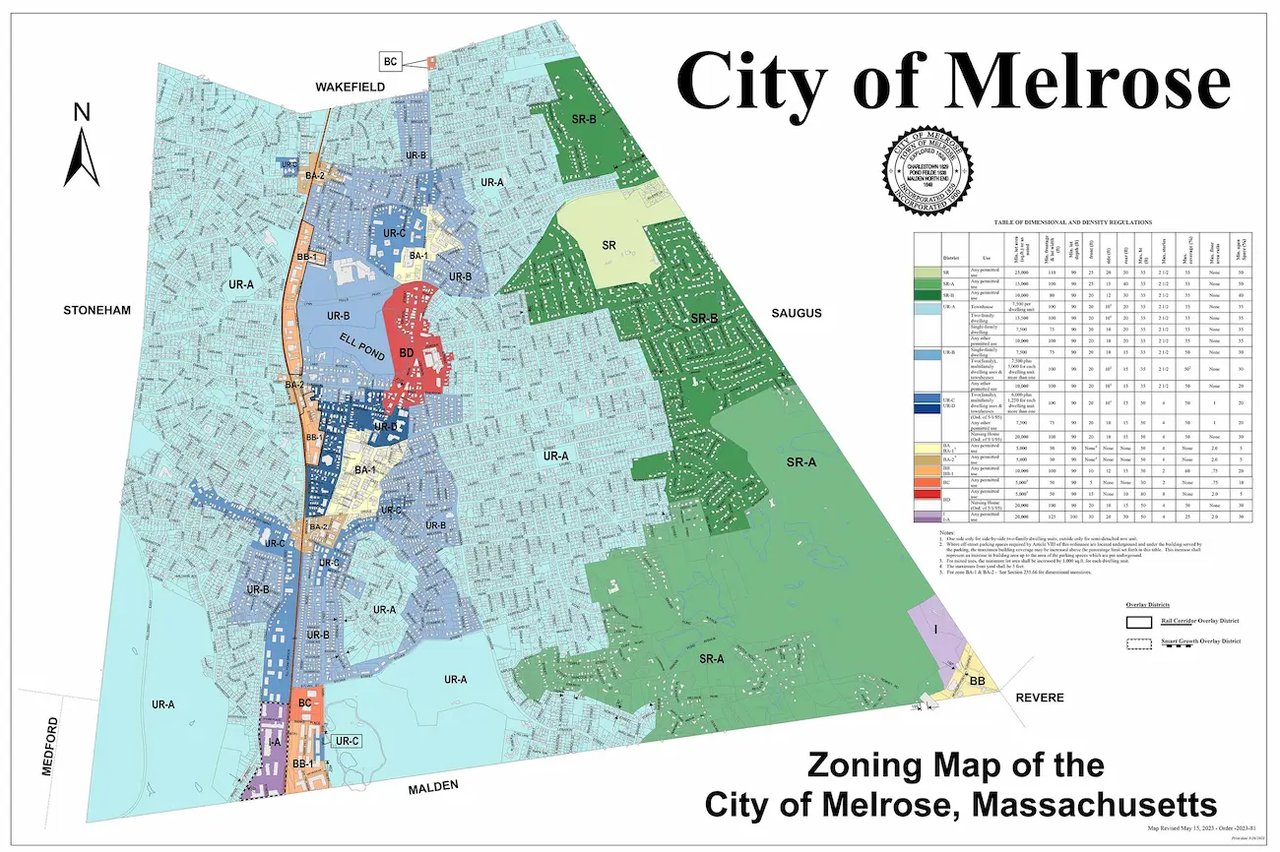
Melrose is compliant with the MBTA Communities Act. The City Council adopted compliant zoning as part of the recodified zoning ordinance on October 21, 2024, allowing multifamily housing by right in districts near the city's commuter rail stations, and the state determined Melrose compliant on September 22, 2025. The state required Melrose to zone for a capacity of 1,892 units. For owners and investors, it can expand what you are allowed to build on a Melrose parcel near transit.
What is Melrose's MBTA 3A zoning?
Melrose meets the MBTA Communities Act through compliance districts the City Council adopted on October 21, 2024 as part of the recodified zoning ordinance, and which the state's Executive Office of Housing and Livable Communities determined compliant on September 22, 2025. As a commuter rail community, Melrose was required to zone at least 25 acres for a capacity of 1,892 multifamily units, about 15 percent of its housing stock, with at least 75 percent of the district inside transit station areas. Inside the districts, multifamily housing is allowed by right at a minimum density of 15 units per acre, meaning qualifying projects no longer need a special permit.
Which parts of Melrose are in the districts?
The districts are clustered around Melrose's three commuter rail stations on the Haverhill Line: Wyoming Hill, Cedar Park, and Melrose Highlands. By state rule, at least 75 percent of the district must sit within those station areas, so the overlay is genuinely transit oriented rather than spread across town. Because the boundaries are parcel specific and some lots are excluded, the only reliable way to know if a property is in the overlay is to check it against the city's adopted zoning map. Send us the address and we will look it up.
What can you build under it?
Inside the districts, multifamily housing is allowed by right at a minimum density of 15 units per acre, a meaningful change from Melrose zoning that had long limited what could be built near the stations. That can turn a parcel that previously allowed only a single home or a two family, or required a special permit for housing, into one where a small multifamily building is permitted as of right. The exact unit count depends on the lot and the district rules, so each parcel needs its own analysis.
What does this mean for Melrose owners and investors?
If your parcel sits in a district, your development potential, and therefore your value, may be higher than the old zoning implied. What that means depends on who you are:
- Investors: Melrose is the most affordable commuter rail entry in the corridor, with three stations on the Haverhill Line straight into North Station, and by right multifamily now allowed near each. That is a strong profile for transit oriented small multifamily, especially compared to Newton or Belmont, where the entry price is meaningfully higher.
- Sellers: it is worth knowing whether your lot carries this upside before you price it, since it can change what a buyer will pay.
- Owners holding long term: the added development rights can sit on your balance sheet as future optionality even if you never build.
We run that analysis before clients buy, sell, or hold.
How do I find out if my Melrose property qualifies?
There are two ways to check, in order of speed:
- Send us the address and we will confirm whether it falls in a district and what that allows, usually same day.
- Or check it yourself against Melrose's adopted MBTA Communities zoning map, published by the city, and look up whether your parcel is inside a district boundary.
| Melrose 3A detail |
Figure |
| MBTA community category |
Commuter Rail |
| Required multifamily zoning capacity |
1,892 units, minimum 25 acres |
| Capacity as share of housing stock |
15 percent |
| Transit area requirement |
At least 75 percent of district within station areas |
| Compliance mechanism |
MBTA Communities compliance districts in the recodified zoning ordinance, adopted October 2024 |
| State compliance status |
Compliant, EOHLC determined September 2025 |
| Typical current multifamily price point |
$1,118,750 |